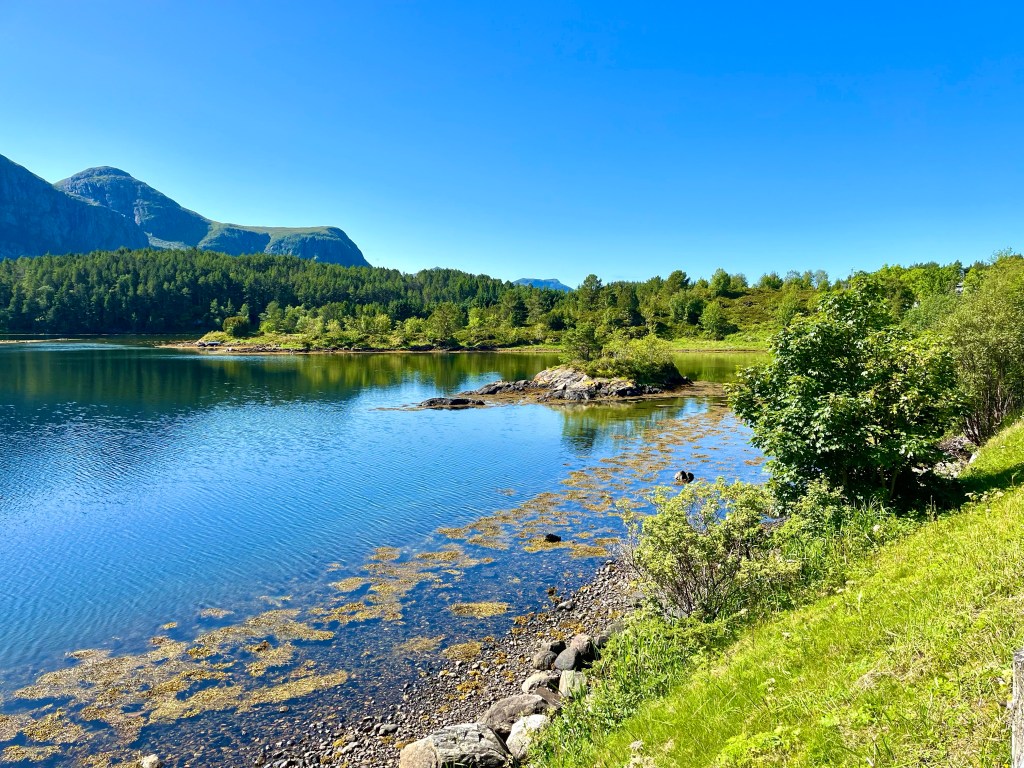
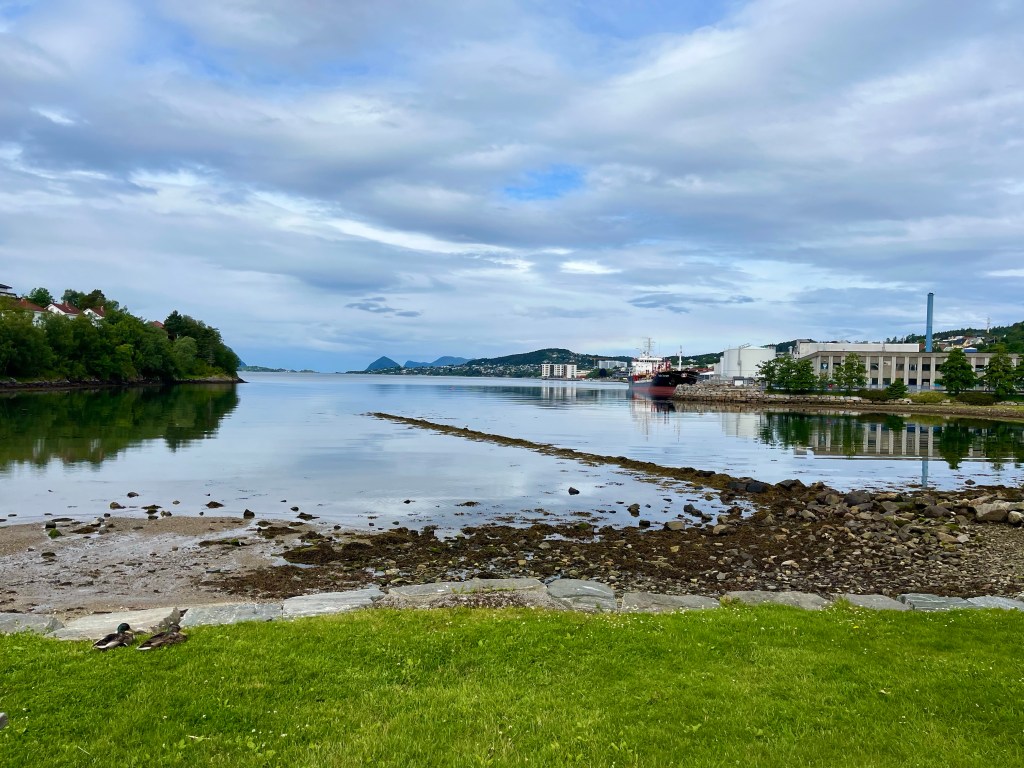
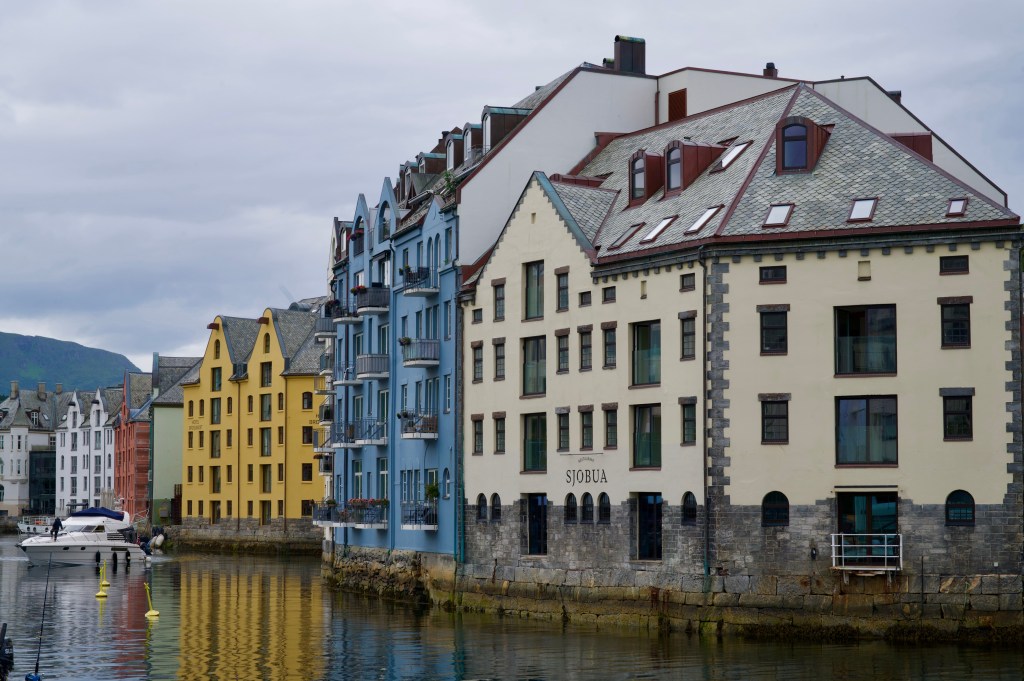
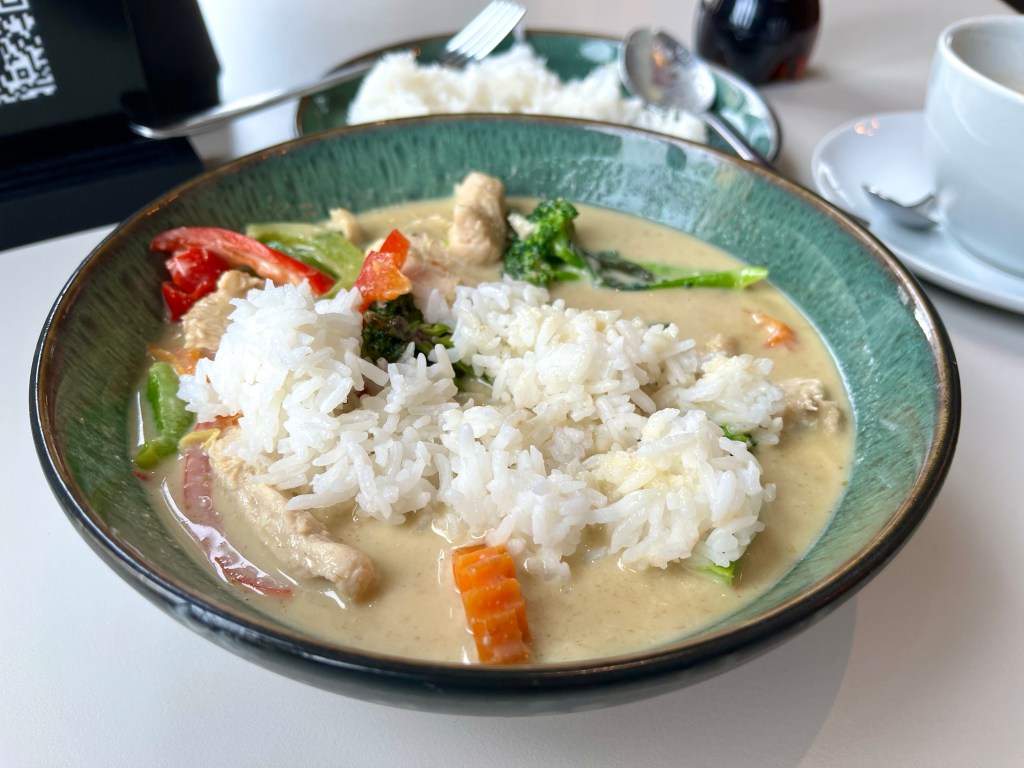
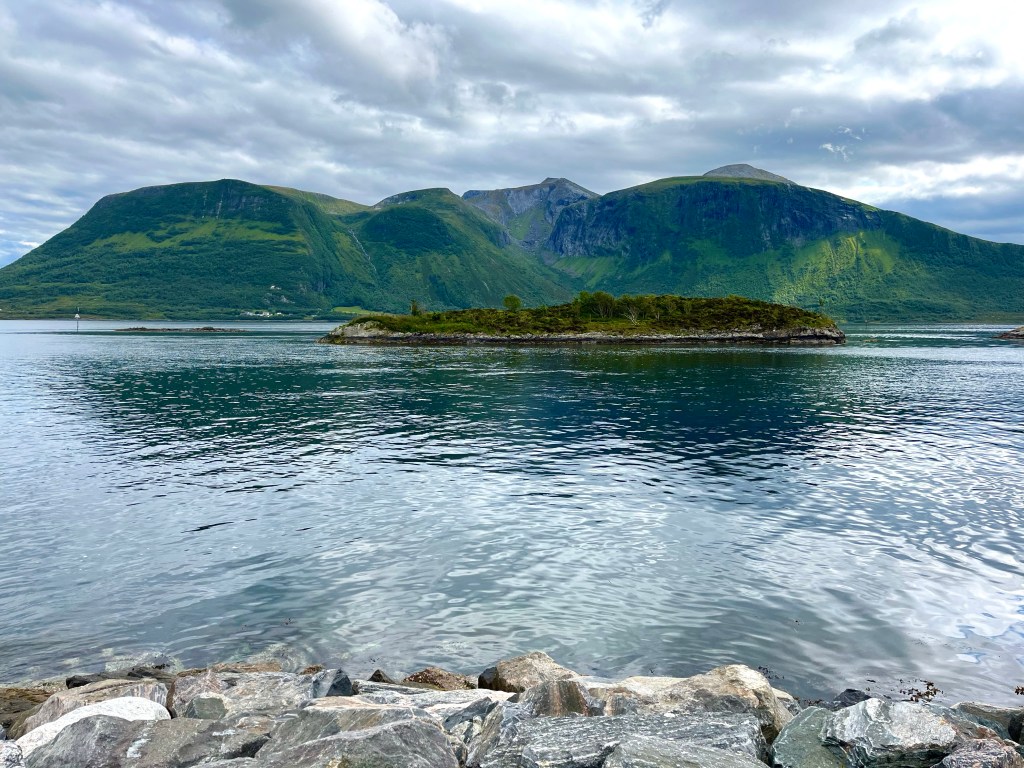
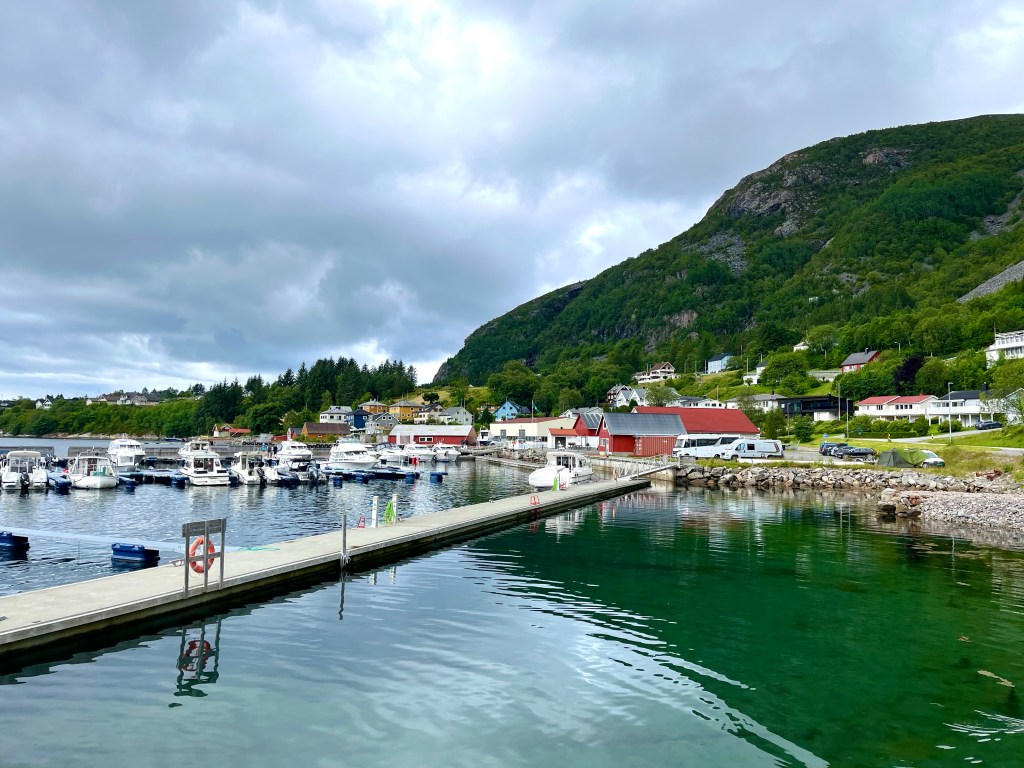
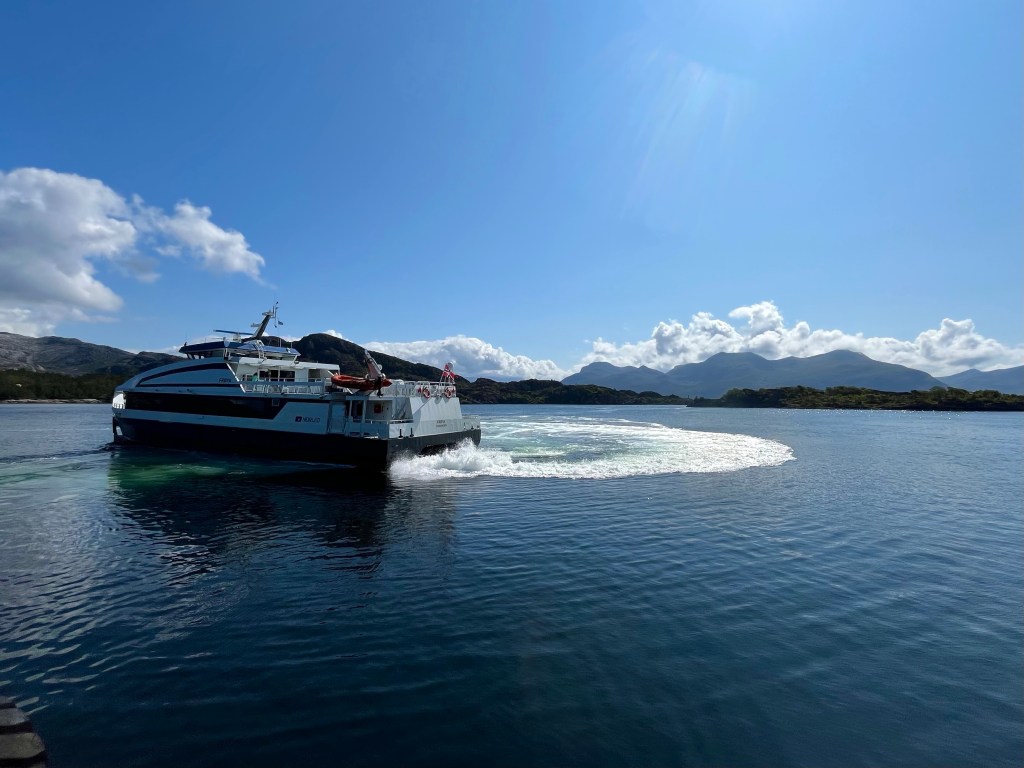
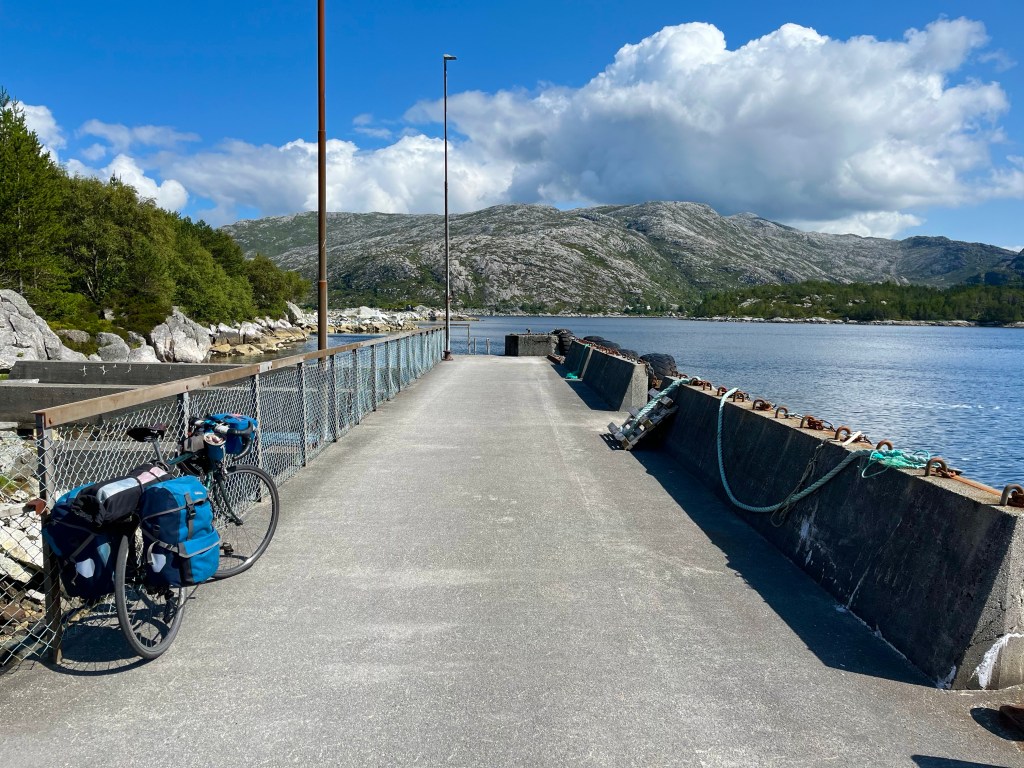
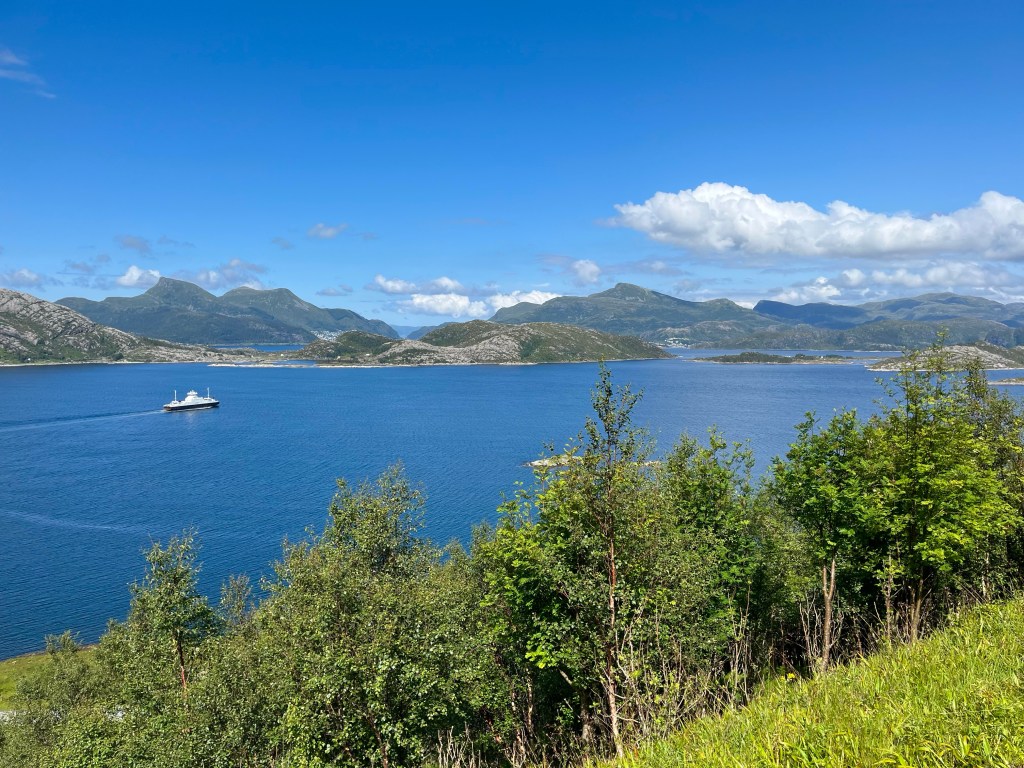
I rushed to pack before heading for the ferry to Smørhamn, arriving at a much larger port than I was used to and not quite sure where the boat would appear. Suddenly, I saw a large high-speed catamaran pulling in near the terminal, so rushed to have a look. When I saw that its destination was Frøya, I thought it must be the wrong boat, until I realised that, although the port of Smørhamn was on the island of Bremangerlandet, it was very close to a causeway to Frøya, so I joined the queue.
The ferry had me across the sound in no time, and I took a little time to soak in the surroundings on what was a beautiful day. A fellow cyclist from Austria, Peter, arrived and we tried to figure out when the next boat would be going the other way. Peter had started out from Nordkapp, 2 and a half weeks before, and was really going some, covering 150 km a day.
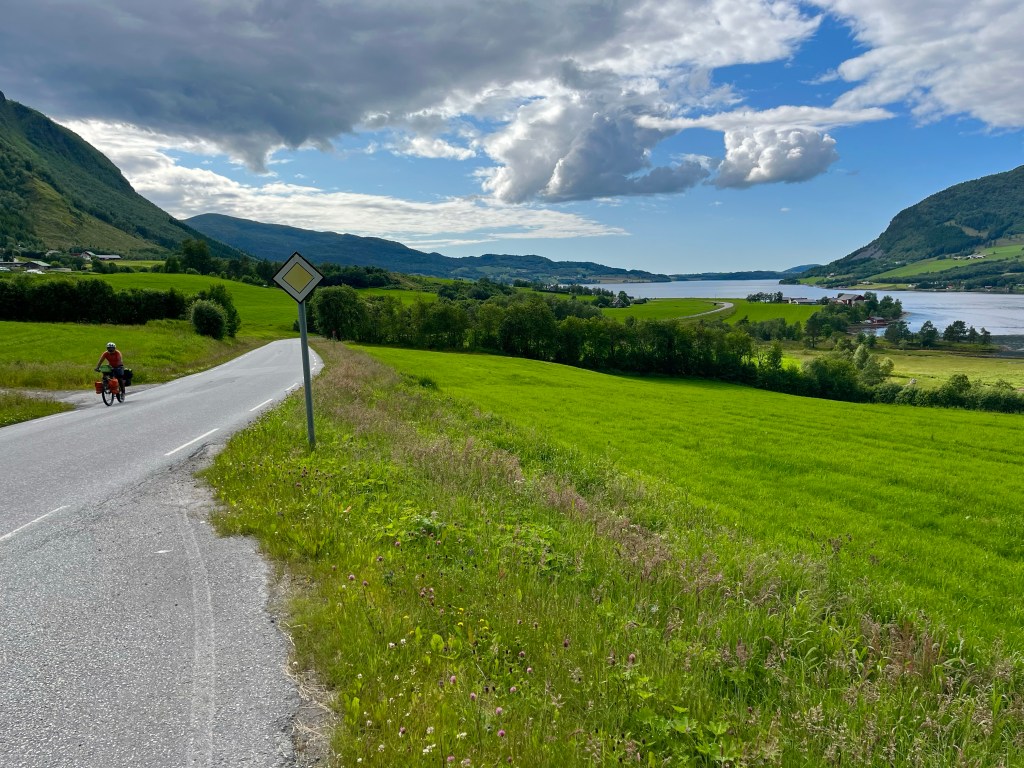
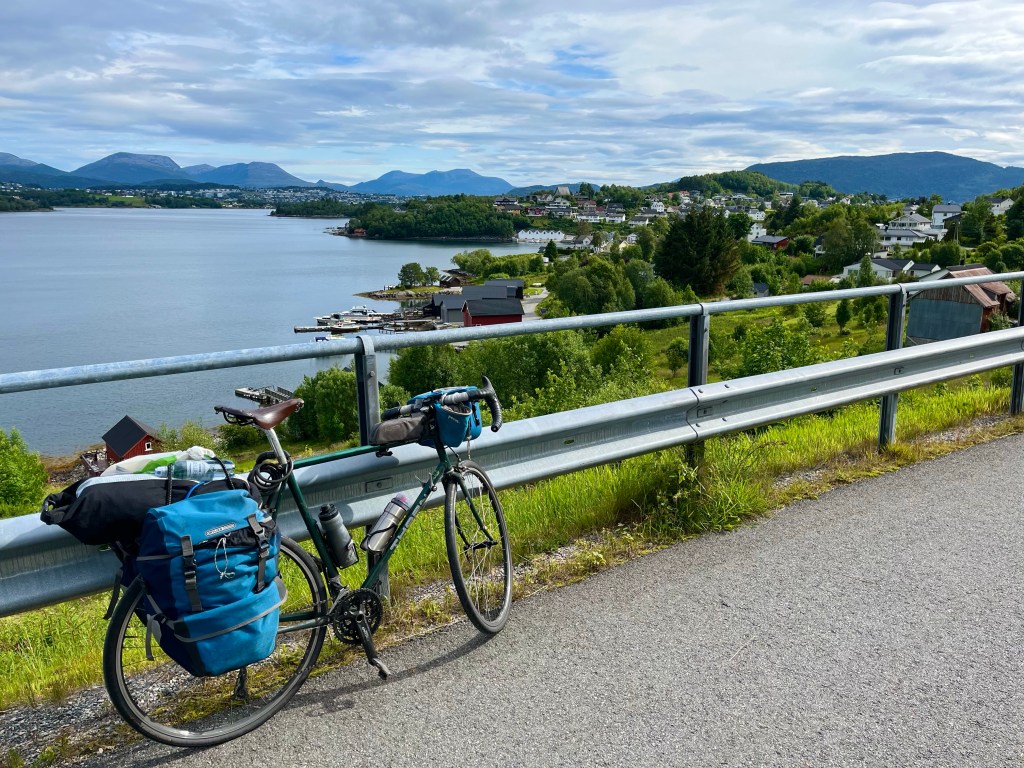
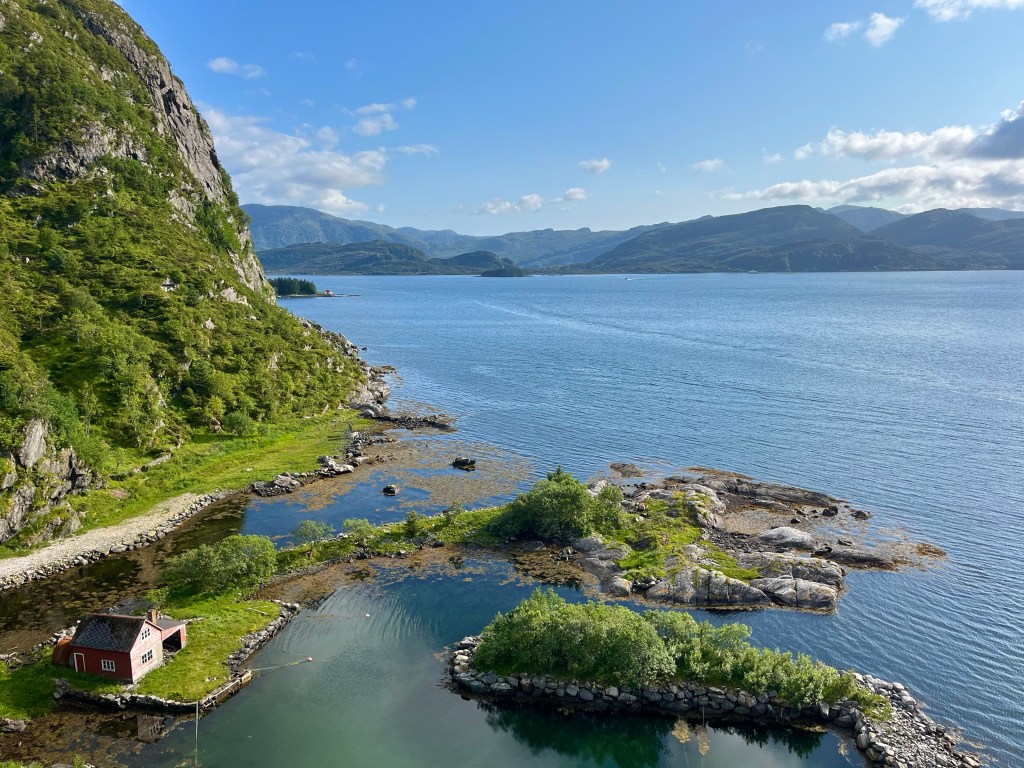
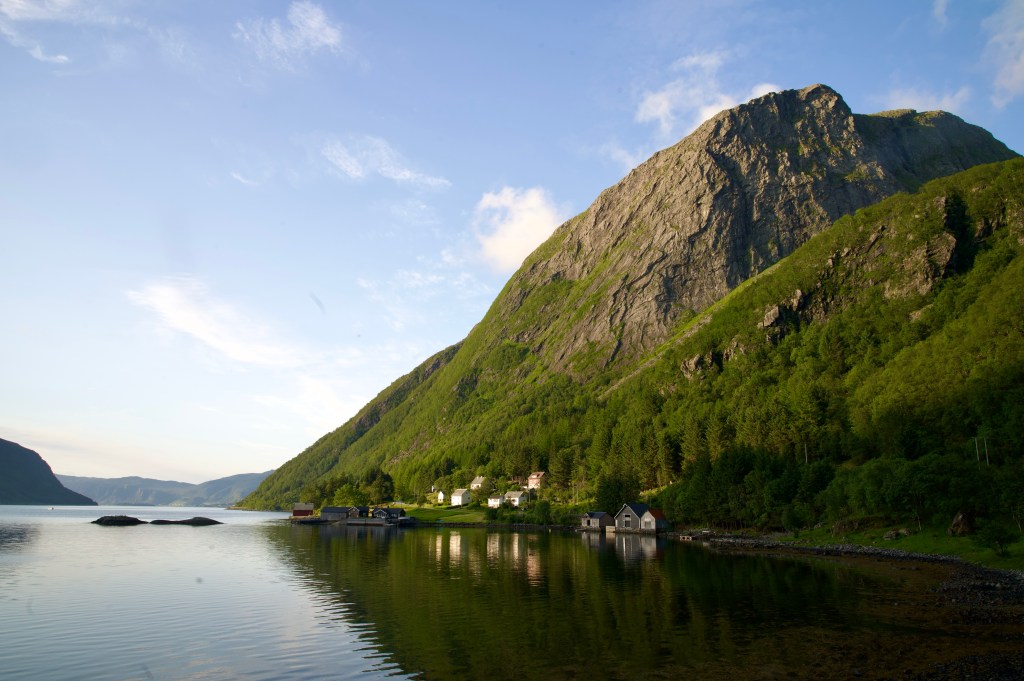
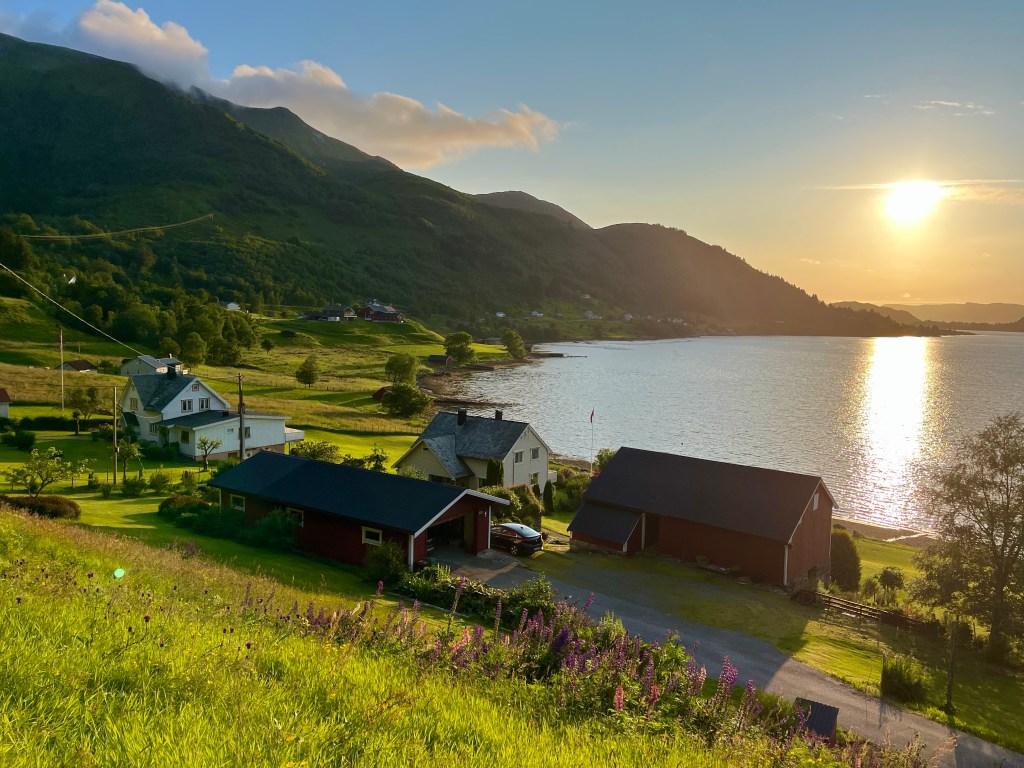
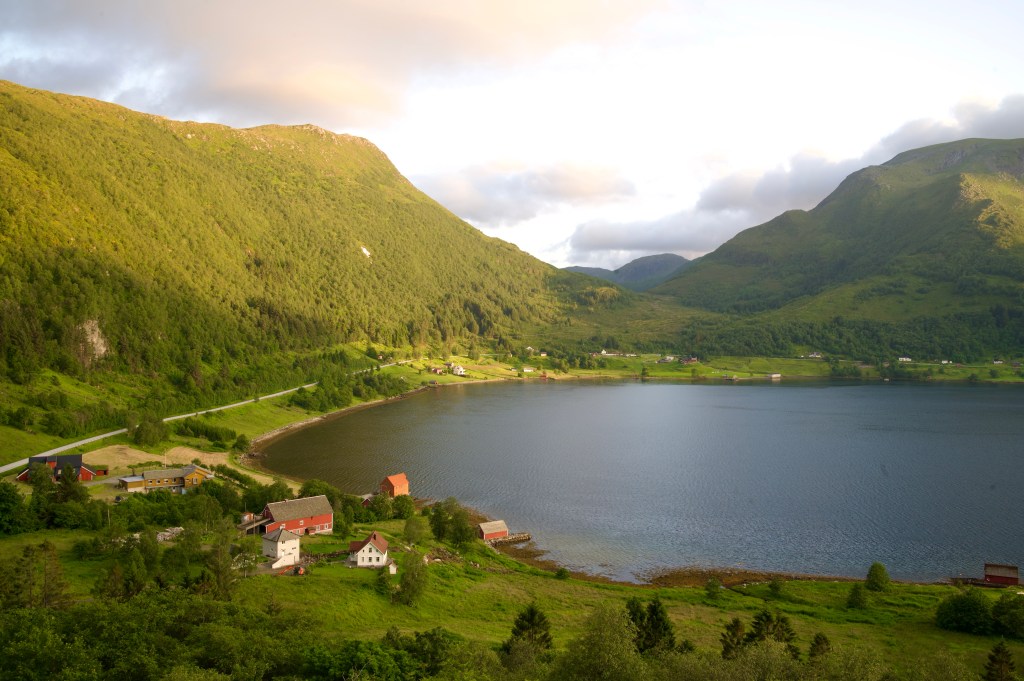
The road across Bremangerlandet was one of the most stunning I’d ever ridden, and for the most part it tracked the edge of the waterline of lakes and fjords while mountains loomed above. Soon, I realised that the ferry off the other side of the island was a little earlier than I was thinking, but that I might just make it if the road remained flat…
But with 2 miles to go the road turned a corner and started to rise, into a headwind, and I knew the game was up.
Emerging from the tunnel at the top of the climb. I could see the boat had already set off, and a few minutes later I was at the pier, with an hour and three quarters to kill.
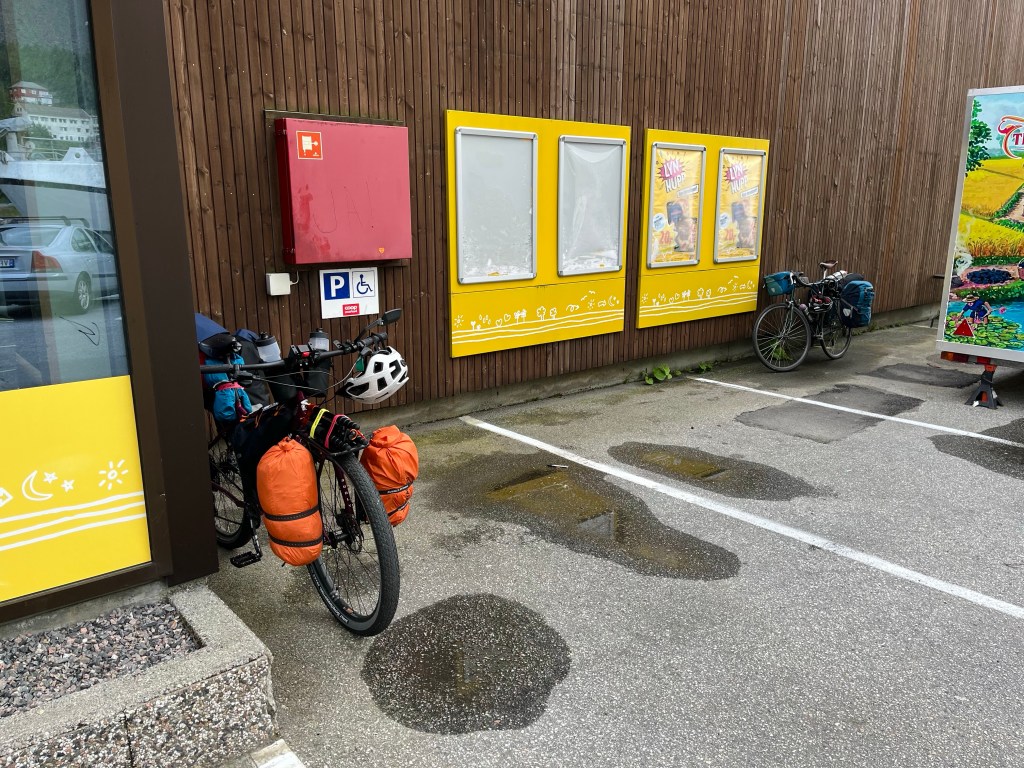
Finding a kebab shop in Måløy, I took on a few calories, before heading to the supermarket to stock up for an evening in the saddle. Some granola, yoghurt, cinammon flavoured lefse (Norwegian flatbread) and a Skolebrød (sweet bread roll topped with custard and icing), being some of the items now commonly found in my panniers.
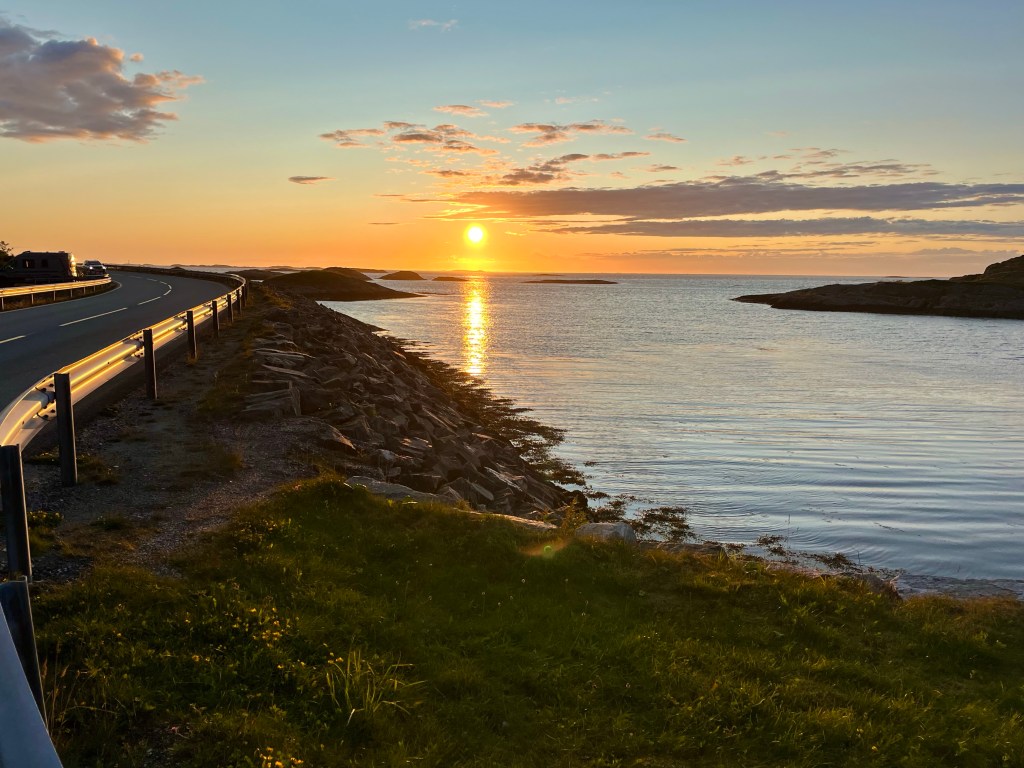
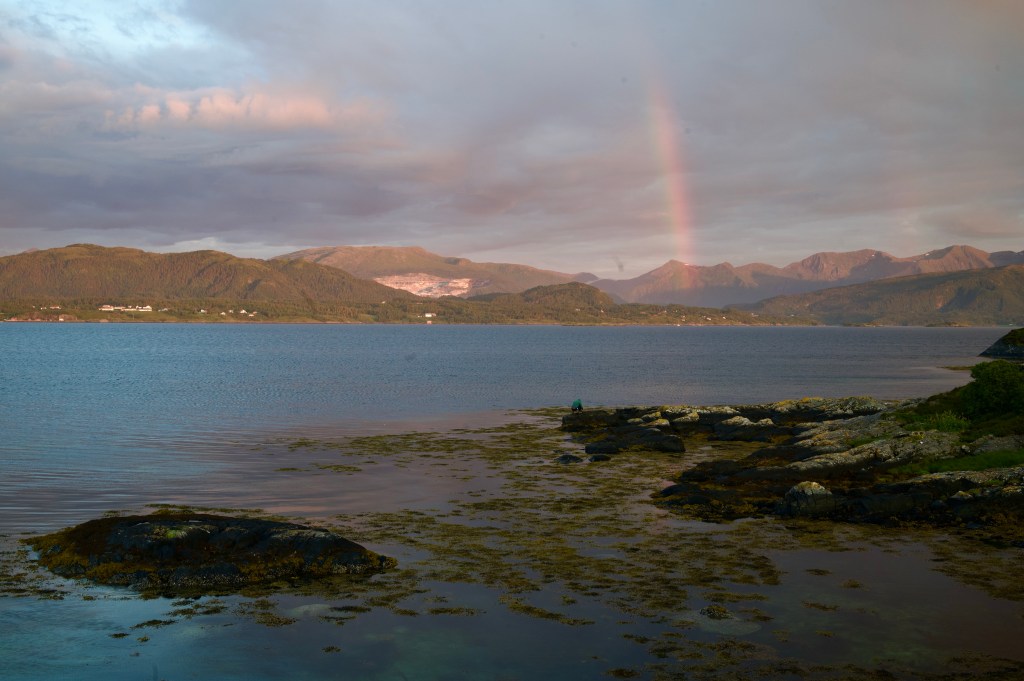
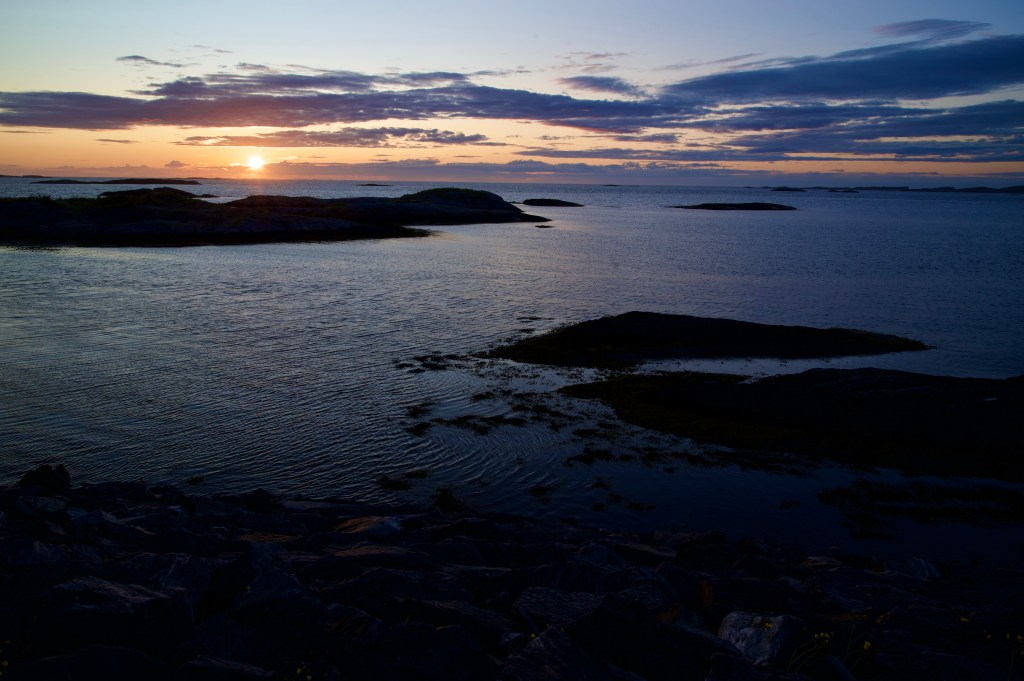
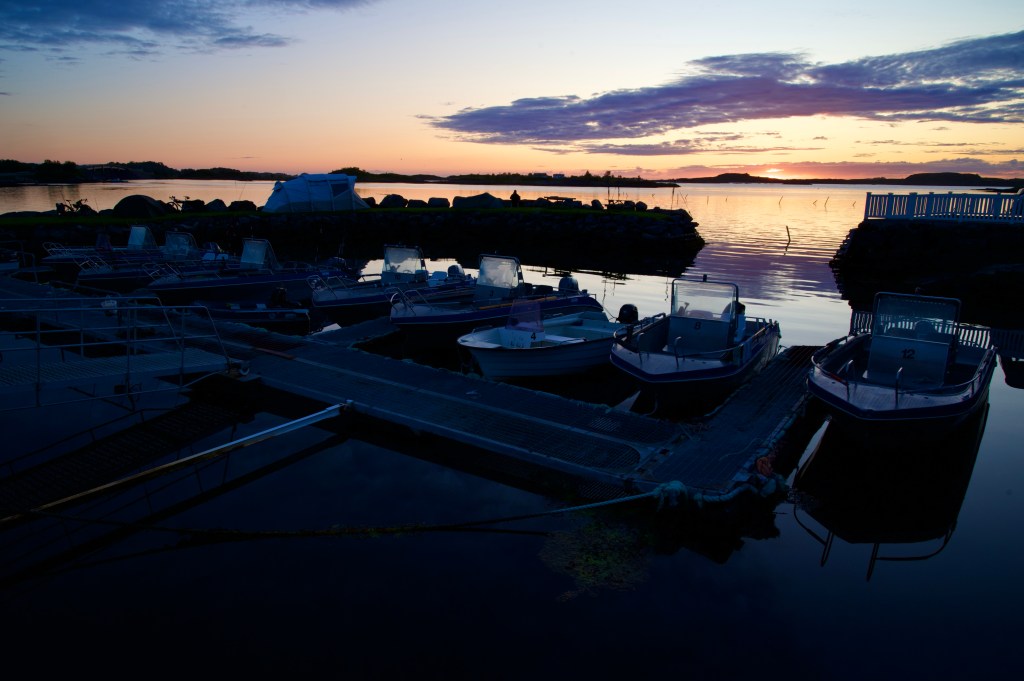
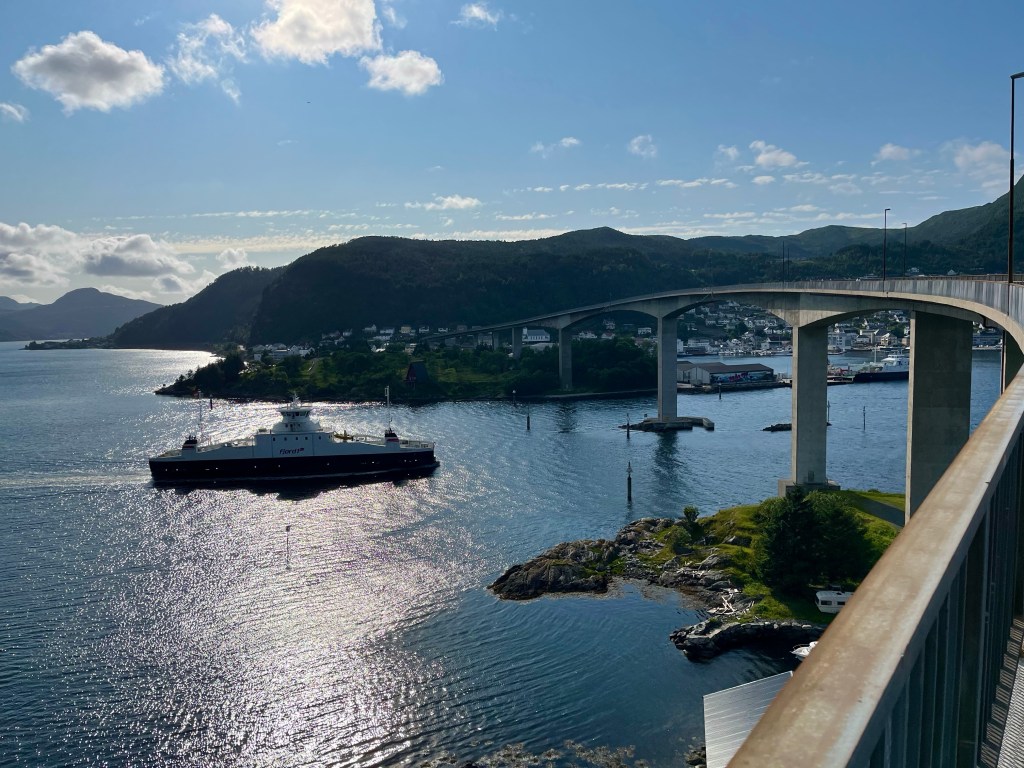
At half past 6 I set off across the sweeping bridge out of Måløy, all set for a night in the fjords. The going was good, with long flat stretches and quiet roads. There was little activity in any of the small settlements that lined the route, the harbour at Flatraket being the exception, with a small motorboat heading out to sea.
For the last hour or two of the day, I was scouring the landscape, looking for anywhere that might give the impression that it would make a suitable camping spot.
With no such luck, I was quickly approaching the hill up and over to Aheim, and it was nearing 10 o’clock. I was concerned that starting up the hill would be a non starter as it would be windier and that would be a problem for my compromised tent.
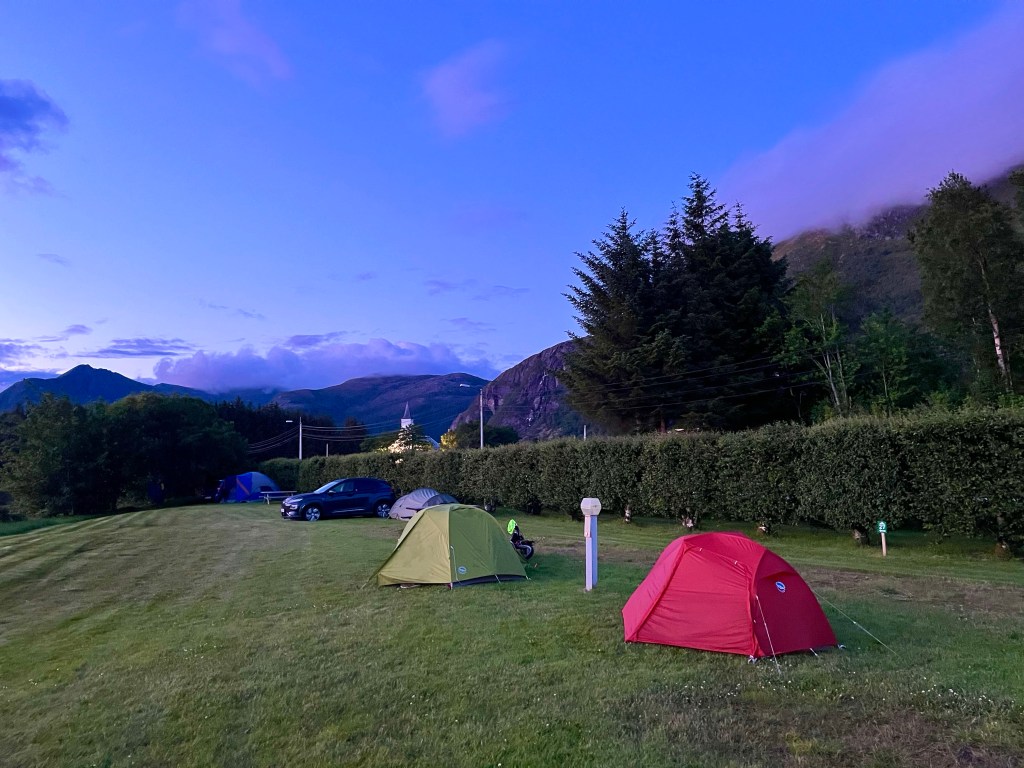
But, Komoot had a possible solution, a user had marked a point at the top of the switchbacks that was out of sight of the road, so I took the chance, and on arriving there thought it was perfect. It was a flat area on top of an old road that had now been overcome by vegetation, and there was some protection from the wind, so I quickly built up my tent, lashing the broken joint with glue and tape, and hoping it would hold the night.
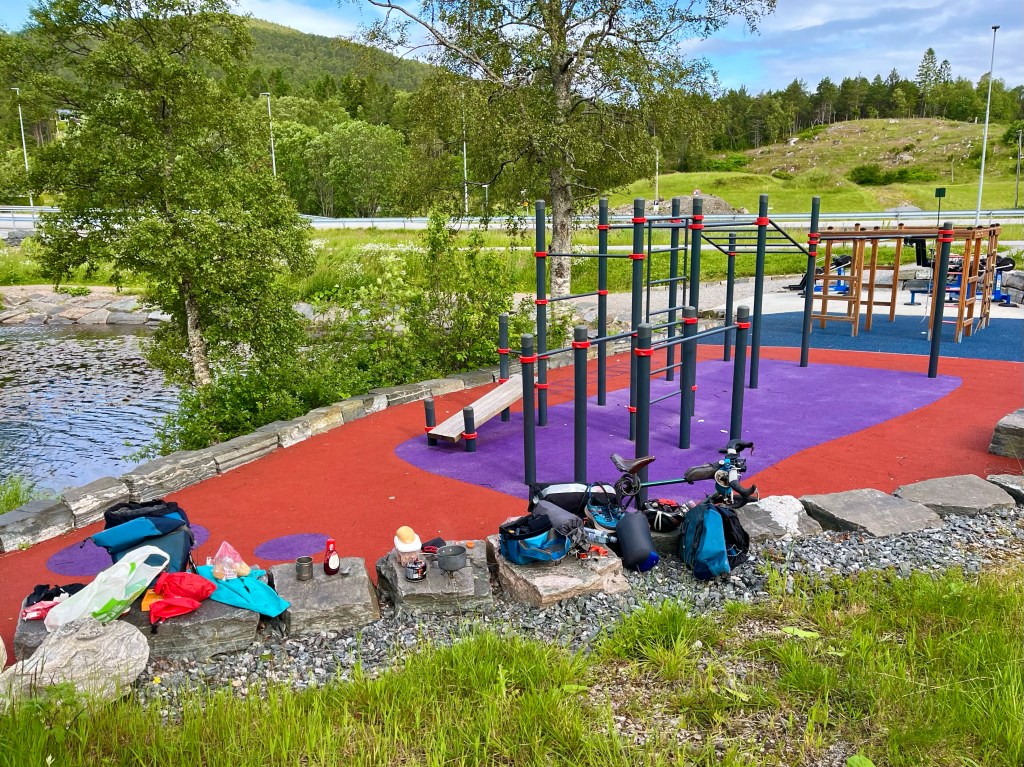
Just beside the tent, there was a handily placed picnic bench, just waiting for me to set up my stove, but wait, what was that? Oh, the midges…
For much of the year, my intention was to cycle the length of Italy during the summer; that is until a freak spring warm spell in Scotland caused me to pause for thought and decide that 3 weeks of cycling in 30°C+ temperatures might not be as fun as I had been thinking.
Luckily, I had been formulating a back up plan, one built upon the itineraries of fellow travellers I’d met on the road and one that might provide a nice change of dynamic, stunning vistas, long days and the low UV index that was now appealing. How about a ride that combined all three – and as it finished up in the Arctic circle and not too far away from the most northerly point in Europe – significant amounts of each.
When I spotted that Jenie and Pierre – who I had met while cycling in Iceland – were cycling in Italy, I thought I’d see what their recommendation would be, receiving a fairly strong signal when it transpired that their favourite place for cycling was Norway and that they’d been three times.
The route I had my eye on was a section of Eurovelo 1, the Atlantic Coast Route, the full route of which began at Nordkapp (the northernmost point of Norway, and Europe) and followed the coast south through Norway, Scotland, Ireland, France, Spain and Portugal.
A significant undertaking, and one that I wouldn’t be able to complete in the 21 cycling days available to me, so I’ll be attempting a portion of it, 1200 miles down the Fjordlands of Norway, from Bergen, to Tromso in the Arctic Circle. With a whole lot of ferries and tunnels along the way, it might not be as straightforward as it seems…
Arriving at the Ferienzentrum Heidenau campsite, I had a familiar issue to other days, the reception was closed and there was a number to call for late check ins. What was the code again, +45? I gave it a ring. No such number, I tried again, then a third time for luck, before remembering that I was in a different country now, the code for Germany was +49.
The site was charming, and although the man on the phone hadn’t really explained where I was to camp – just telling me to take the second turn on the right – I knew it when I saw it, the quaint duck pond, surrounded by trees and where a smattering of other tents were already set up.
Retracing my steps, the following morning, I continued by turning down some quiet country lanes, navigation aided by a couple of cyclists in the distance. eventually reaching Sittensen, where I hoped to stop at the supermarket to buy supplies, before quickly pressing on. My plan appeared to have been foiled when I passed a large Edeka superstore on the way in. It only appeared to be open from Montag to Samstag, and this was a Sonntag. It was the same story at both Aldi and Lidl, was I still in the 21st century I wondered? The answer was yes, and all the shops in Germany were closed on a Sunday.
Plans scuppered, I resigned myself to having to visit ‘Soul Kitchen’ for a Black Angus burger and sweet potato fries, it tasted pretty good, but I still wasn’t happy about it.
Much later than expected, I headed out of town, in the direction of Gross Meckelsen, the route winding its way between the fields. Open stretches into the wind were a chore and I was frustrated at how slowly the miles were ticking by, soon reverting to counting in kilometres instead.
Like Sittensen, the pedestrianised centre of the large town of Zeven was like a ghost town, and I noted that the roads were much quieter than they had been for the rest of the week, too.
I started aiming for the village after next as a ploy to keep myself on the bike a little longer between stops, from Kirchtimke, I skipped Westertimke and kept on rolling to Tarmstedt, where I paused briefly before turning onto Bremer Landstrasse, on the final approach to Bremen.
On reaching the city limits at Lilienthal, I briefly followed a tram into town, before the route skirted north around a large pond on the outskirts and down a busy mono-blocked cycle path, towards the old town.
Skirting around the inside of the city walls, I past the Kunsthalle Bremen art gallery and crossed the Weser river onto a large river island, or Werder (from where the local football team get their name) to reach the Reisemobil Stellplatz campground. The reception was closed, and the windows of the building featured a barrage of information, in German, that even my trusty translate app could not make head nor tail of.
With the time ticking beyond half past 7 at night, I didn’t have a lot of time to spare, so quickly phoned the next nearest campsite, HanseCamping Bremen, some 5 miles away, and back in the direction I’d just come, to see if I could stay there. Ja, was the quick reply, but you’ll need to get here by 8.
Spinning the pedals as fast as my legs would allow, I ploughed back through the centre of the Bremen old town, before ending up on a different route out of town, through a forest on a rough gravel track – the affect on my tyres, not something I’d be worrying about right now.
Almost taken by surprise, I arrived at the site by the back door, rushing into the reception at 19:56, I couldn’t believe I’d managed the 5 mile route in under 23 minutes. At best the proprietor looked bemused, what was all the fuss about?
Still to have dinner, I tried the restaurant at the door of the campsite, but they had stopped serving, so I cycled back to Landhaus Kushiel, a pleasantly situated restaurant – with beer terrace overlooking the canal – that I had passed on the way in several hours ago, but although its opening hours were until 11, it was already closed, at 9 o’clock.
Finally, after a 5 mile round trip, I found an Italian, Bellini im Tresor, at the far side of the large University campus, they were still serving, and when they did, it was worth the wait. I had tagliatelle with beef and girolle mushrooms in a truffle sauce, all washed down with a pleasant, citrusy, half litre of Alster beer. I was relieved to finally get my fuelling started for tomorrow.
So, I was stuck in Wadi Musa, three of my four inner tubes had punctures. There were no bike shops in the area, and realistically the only place that there was any hope of getting a replacement one was in Aqaba, 80 miles away, and where I planned to finish.
The way I saw it, I had several options:
Repair as many inner tubes as I could and set off, hoping to cover the 80 miles to Aqaba, largely across the middle of a desert.
Repair as many tubes as I could, struggle the 65 miles to Wadi Rum village and hope to catch the 18:30 bus to Aqaba.
Cycle the 20 or so miles to the end of the King’s Highway, then bail out the other way, along the desert highway, heading for Ma’an and hoping to find a bus.
Take the 17 mile direct route to Ma’an and hope to catch a bus.
Pay a Bedouin to take me all the way to Aqaba…
Those were the options I had, until I interrogated the website for the intercity coach company JETT a little further and discovered that, although Ma’an was a major transport hub in the desert and that the Amman – Aqaba bus passed quite close, it didn’t actually stop there. The only buses leaving from Ma’an were minibuses, which were small, had no schedule, and waited until they were full before departing. That didn’t sound ideal to me. My options were narrowing towards needing to cycle all the way to Aqaba, I’d better fix some punctures…
Before dinner, I investigated the two spare inner tubes that were in my bag. Finding a tiny tear in one, I repaired that quickly enough, then, turning to the other, I discovered that the repair I’d attempted the day before hadn’t worked, so I replaced that patch with another. By this time the first one had deflated again, and I found a second hole on a seam.
After dinner, these tubes were still inflated, hanging as I left them, so my attention turned to the remaining punctured tube on my bike. I was down to my last puncture repair patch so I hoped for the best.
Waking in the morning, I found this third tube was flat again, eventually finding, it too had a second hole. Luckily, I hadn’t thrown away the patch from the earlier failed repair, and although its condition looked questionable, it was the best I had.
Setting off at half past 8, I started the long climb out of Wadi Musa, assuming I departed the way I came in, I climbed up a steep hill out of town, then realised that I was heading the wrong direction when I stopped to take a photo.
Back on track, the road climbed at a gentle gradient, the heat of the sun tempered by a pleasant cooling breeze. When a tour bus pulled off the road up ahead, I followed suit, looking out over the Shara mountain range, and the outer extremities of Petra’s extent.
Having started at 1250m elevation, the road had soon climbed up to 1550m and I wondered if this was the top as I skirted around the shoulder of the mountain. Alas no, as I dropped into the quaint mountain village of At-Taybeh, I could see the road rise again in front of me, and soon I was at 1570m.
Rolling through a police checkpoint, I was afforded a choice, Ma’an to the left of me, Aqaba to the right. With over 15 miles gone and not yet any wheel-based concerns, I was happy to commit.
After 20 miles, I had only just passed some Bedouin farmers tending a herd of goats, when I reached the highest point of the whole route at 1695 metres.
Eventually, I reached a dilapidated cafe building, high on the plateau, pausing momentarily to take in the stunning Wadi Rum views.
Soon afterwards, the road started to trend downwards, and it wasn’t long before I reached the desert highway, and conversely, the end of the King’s Highway.
As I turned onto the highway I was waved over by the police, and this, I felt, was the moment of truth. I knew that organised tour groups required police chaperones to ride parts of the route. How would the police feel about a lone cyclist setting off along the country’s major highway for 40 miles. ‘Wadi Rum?’ (I’d understated my ambitions a little) ‘en bicyclette sport?’, ‘have fun’ came the stern rebuke…
The first few miles along the desert highway were sensational, the beautiful tarmac surface, expediting my arrival down to 1200 metres elevation, and a significant temperature gain. As I flew, I overtook lorries as I went, perhaps treating my brakes a little less cautiously than their drivers were.
It had been a remarkable piece of road, but I should have known it wouldn’t last. As I started to pass between the towering stacks of the Wadi Rum desert, the condition of the surface deteriorated rapidly, with large cracks stretching across the carriageway and huge gouges right through to the road bed.
As I approached the turn off to Wadi Rum village, I couldn’t believe my eyes when I saw a cycle tourist pull out of a petrol station up ahead and join the road in the direction I was travelling. Accelerating to catch up, I moved alongside.
This was Gabi, a cyclist from New Zealand who had been living in Georgia and had just started a 1 and a half year adventure to pedal down the east coast of Africa, and, if she had any time left, to cycle west to east across Europe afterwards. She had started her trip – her first ever cycle tour – in the north of Jordan and had been cycling down the desert highway, having driven the King’s Highway beforehand.
We soon realised that Gabi had missed her turn – as she was headed for Wadi Rum Village – so we stopped to chat a little more by the roadside. Before long, a vehicle pulled up, a man travelling to Aqaba was wondering if we needed a lift, but once he heard that Gabi was making for Wadi Rum, he rushed to give her the details of his family home, so she had somewhere to stay when she got there. As for me, grateful of the offer as I was, I politely declined, today was a day for making amends for some of my cycling performances earlier in the week…
Although the road threatened to climb a few more times, it never did, and I found that I’d been cycling for mile upon mile at over 18 miles an hour, the downward gradient bolstered by a light tailwind. For the last 5 miles, the road careered downwards at a yet more significant rate, as the road cut through a narrow cleft in the rock.
As I rolled down the fine boulevard of Al-Hussein Bin Ali Street, after more than 80 miles in the saddle, the sun was setting as I made for the Red Sea coastline. Reaching the front in Aqaba, my satisfaction was tempered by the fact that I couldn’t actually get there due to the unbroken chain of exclusive hotels with their own private beaches.
By the time I found a vantage point, the sun had already set, as it had on my ride. After some trying days earlier in the week, this journey really had ended on a high. I’d loved my extra day in Wadi Musa, glad I gave myself the time to see Petra properly, and today’s cycle had been fantastic. The road had climbed for almost 20 miles, but at a manageable gradient and with special views, and the 40 mile stretch down through the desert of Wadi Rum, was probably the best descent I’d ever had.
All that remained, was for my bike and I to make it home. but for that, a few little uncertainties needed to be ironed out first…